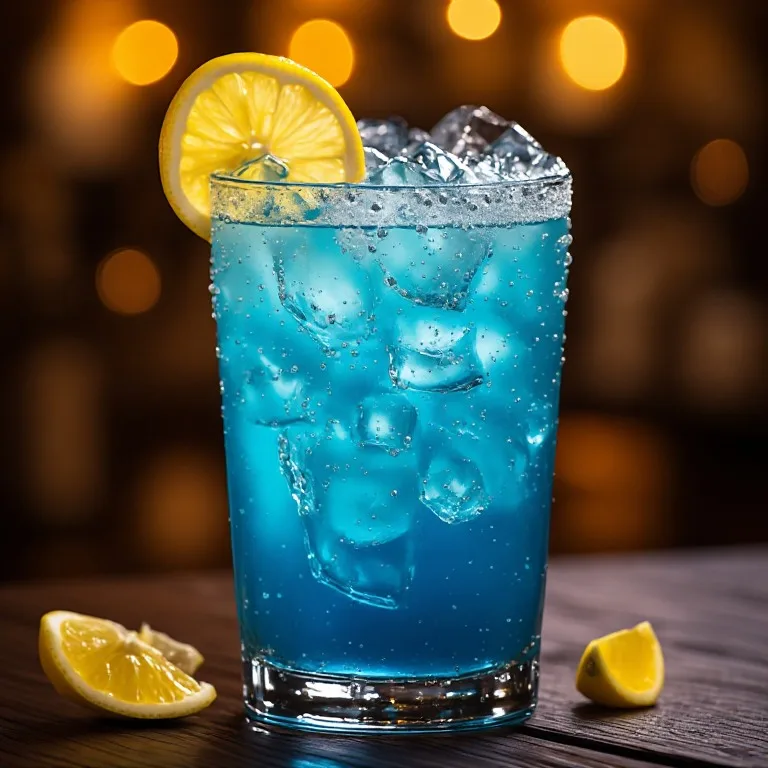
Hooters built its drinks identity around cold beer, frozen tropicals and brightly colored coolers meant for a table watching the game. The Blue Hooterade fits that last category perfectly: berry vodka, orange liqueur, lemonade and soda in an unmistakably blue glass.
The name sounds like a sports drink, but the cocktail is a sweet, carbonated vodka highball. The important distinction is that Hooters menus are not identical across the country. Different franchise groups carry different drinks, and even the Hooterade flavor lineup can change by location.
What Hooters Actually Serves
Current official Hooters of America location pages still promote “colorful Hooterades” alongside the Legendary Rita and 3 Mile Island Bloody Mary. Published nutrition databases list Blue Hooterade at about 210 calories per serving. A Hooters-branded staff study guide identifies its components as raspberry vodka, blue curaçao, agave syrup, lemonade and Mountain Dew.
What the chain does not provide publicly is a current national recipe with measurements or a universal price. This version follows the documented ingredient list and lands close to the published calorie profile, but it is a home reconstruction rather than a leaked official formula.
The originally suggested Beach Water could not be verified on a current official Hooters menu. That is why Blue Hooterade is the more defensible copycat.
Why Typical Blue Coolers Miss
The obvious mistake is treating blue curaçao like food coloring. It is a sweet orange liqueur, and an oversized pour makes the drink syrupy before the lemonade or soda even arrives. Three-quarters of an ounce provides saturated color and a clear orange note without swallowing the raspberry.
Another mistake is shaking the soda. Carbonation expands violently in a sealed shaker and disappears quickly after opening. Shake only the still ingredients, then add the fizzy topper in the glass.
Finally, avoid adding extra blue coloring. Blue curaçao supplies enough color on its own. Artificial color makes no flavor contribution and can turn an appealing cobalt drink into something opaque.
The Key Technique: Build the Fizz Last
Briefly shake the raspberry vodka, curaçao, lemonade and agave with ice. Eight seconds is enough because this is not a silky sour that needs heavy aeration. Strain over fresh ice so the final drink stays cold without carrying broken shaker ice into the glass.
Pour the citrus soda down the inside wall, then use a bar spoon to lift the bottom of the drink once. Vigorous stirring drives away carbonation. The goal is an even blue color with a lively top, not a flat glass of sweet punch.
Taste your lemonade before measuring the agave. A tart homemade lemonade benefits from the full quarter ounce. A bottled lemonade that already tastes candy-sweet may need only a teaspoon or none at all.
Make Eight for Game Day
Combine 10 oz (300 ml) raspberry vodka, 6 oz (180 ml) blue curaçao, 16 oz (480 ml) chilled lemonade and 2 oz (60 ml) agave syrup in a pitcher. Refrigerate for up to four hours.
To serve, stir the batch, divide it evenly among eight ice-filled highballs and top each glass with 1½ oz (45 ml) Mountain Dew or lemon-lime soda. Do not add soda to the pitcher in advance; it will go flat while guests refill their glasses. Set out lemon wedges separately.
The Blue Raspberry Gameday Cooler
Leaving out the spirits would also remove most of the berry and orange character. Strong raspberry herbal tea restores the tart fruit note without alcohol, while alcohol-free blue curaçao syrup handles both the orange flavor and color.
Check the curaçao label carefully. Blue curaçao liqueur contains alcohol; the mocktail needs a syrup explicitly labeled alcohol-free. Because that syrup is usually sweeter than the liqueur, the mocktail does not need agave.
Hooters may change a local drink menu long before every location page catches up. Treat the restaurant version as location-dependent and this recipe as a measured way to recreate the documented Blue Hooterade profile at home.
See more famous restaurant cocktails →