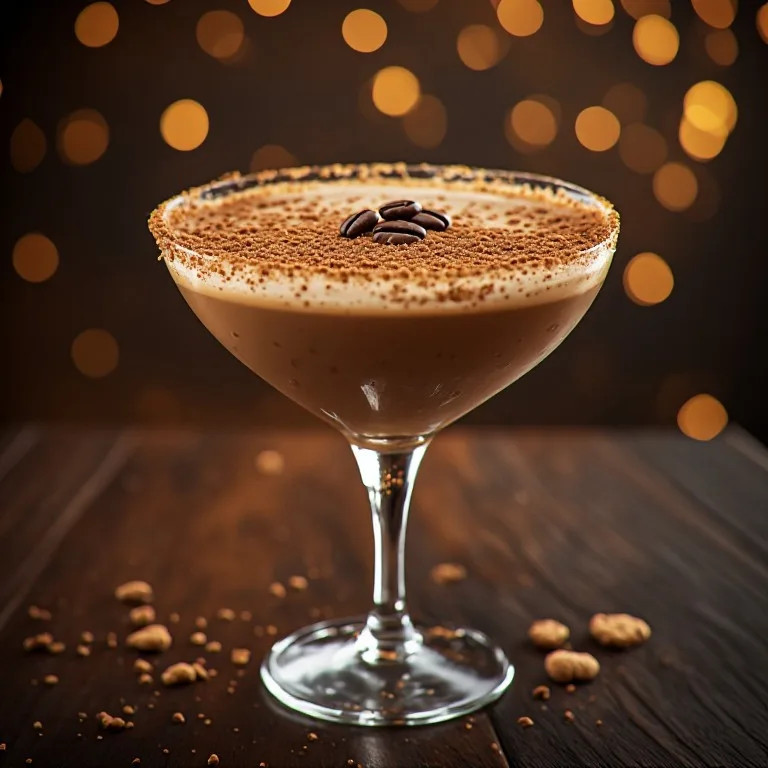
The Gingerbread Espresso Martini turns a familiar after-dinner drink into a holiday dessert without adding cream. Espresso provides bitterness and foam, coffee liqueur supplies roasted sweetness, and gingerbread syrup brings ginger, cinnamon and clove. A crumb half-rim gives each sip a cookie aroma without coating the entire glass in sugar.
This is a real seasonal cocktail style, but it is not one famous bar’s protected formula. Multiple brands and bars publish different versions. The best-supported simple build comes from Kahlua: equal parts vodka, coffee liqueur and espresso, plus half a part of gingerbread syrup.
What the Documented Versions Use
Kahlua’s published recipe calls for 1 oz each of Kahlua, Absolut Vodka and espresso with 1/2 oz of gingerbread syrup. It finishes the drink with a gingerbread crumb half-rim. Mr Black publishes another credible version that swaps vodka for spiced rum and uses its own coffee liqueur, espresso or cold-brew concentrate, syrup and a caramel-bound crumb rim.
The Bellevue Chicago introduced a documented seasonal version in November 2024 with vodka, fresh espresso and house gingerbread syrup. These examples verify the drink as a recurring holiday format. They do not prove one inventor, one viral launch date or one universal recipe. Availability is usually tied to November and December menus, so a permanent menu claim would be misleading.
Why Typical Versions Taste Flat
Too much gingerbread syrup makes the drink taste like a coffee-shop flavor pump. Coffee liqueur is already sweet, and a cookie rim adds another sweet element. Half an ounce of syrup is enough to carry spice through the espresso without burying its roast.
Weak coffee is another problem. Regular chilled coffee adds water but little bitterness or body. Use a fresh espresso shot or a true cold-brew concentrate. If the bottle is designed to drink by the glass, it is probably too mild for this recipe.
Finally, many home versions lose their foam because the espresso is old or the shake is timid. Espresso’s oils and dissolved solids help trap air, but only vigorous shaking creates the tight cap associated with the drink.
The Key Technique: Manage Heat and Air
Fresh espresso is helpful, but piping-hot espresso melts too much ice. Pull the shot first and let it stand for about 2 minutes while you chill and rim the glass. It should still be fresh, just not hot enough to flood the shaker with dilution.
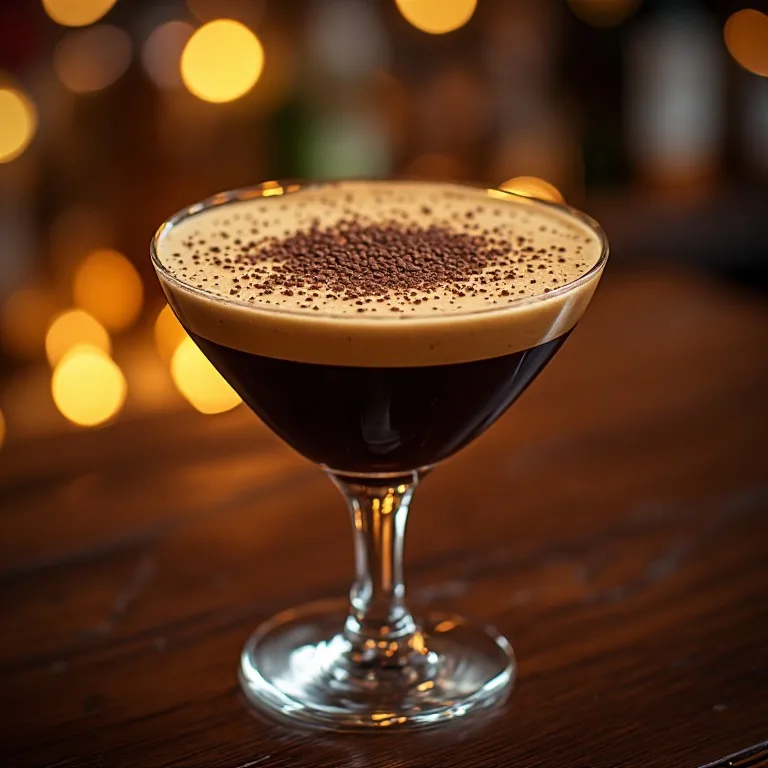
Fill the shaker generously with firm ice and shake for 15 to 20 seconds. A hard shake both chills the mixture and forces air through the coffee. Fine-strain immediately, holding the shaker close to the coupe so the stream stays controlled. The drink should settle into a dark base with a tan foam cap.
Only rim half the glass. Guests can choose a cookie-coated sip or a clean sip, and loose crumbs are less likely to fall across the foam.
Batch It for a Holiday Party
For eight drinks, combine 8 oz (240 ml) vodka, 8 oz (240 ml) coffee liqueur and 4 oz (120 ml) gingerbread syrup in a sealed bottle. Refrigerate for up to two days. Prepare the crumb mixture and chill the coupes ahead, but wait to rim them until shortly before service.
For each order, measure 2 1/2 oz (75 ml) of the batch with 1 oz (30 ml) fresh espresso into a shaker. Shake hard with ice and fine-strain. Espresso should not sit in the party bottle because its aroma fades and the mixture still needs individual shaking to produce foam.
The Zero-Proof Gingerbread Cold Brew Flip
Removing vodka and coffee liqueur can leave a mocktail that tastes like sweet iced coffee. A 0.0% coffee spirit restores roasted complexity, while strong decaf black tea contributes tannin and a dry finish. The result still has enough dissolved coffee material to foam when shaken hard.
Check the coffee-spirit label if complete alcohol avoidance matters. Products labeled nonalcoholic can sometimes contain trace alcohol, while a clearly marked 0.0% option is the straightforward choice. Use decaf espresso and tea for a lower-caffeine evening version, remembering that decaf can still contain a small amount of caffeine.
The finished cocktail should taste first of espresso, then warm spice, with cookie sweetness at the edge of the glass. That order keeps it a cocktail rather than a liquid dessert.