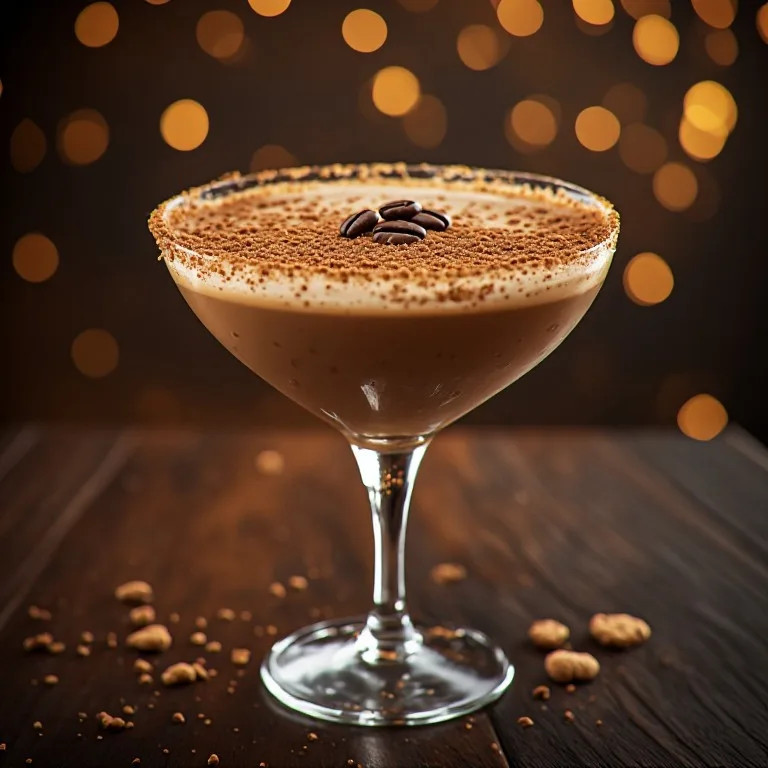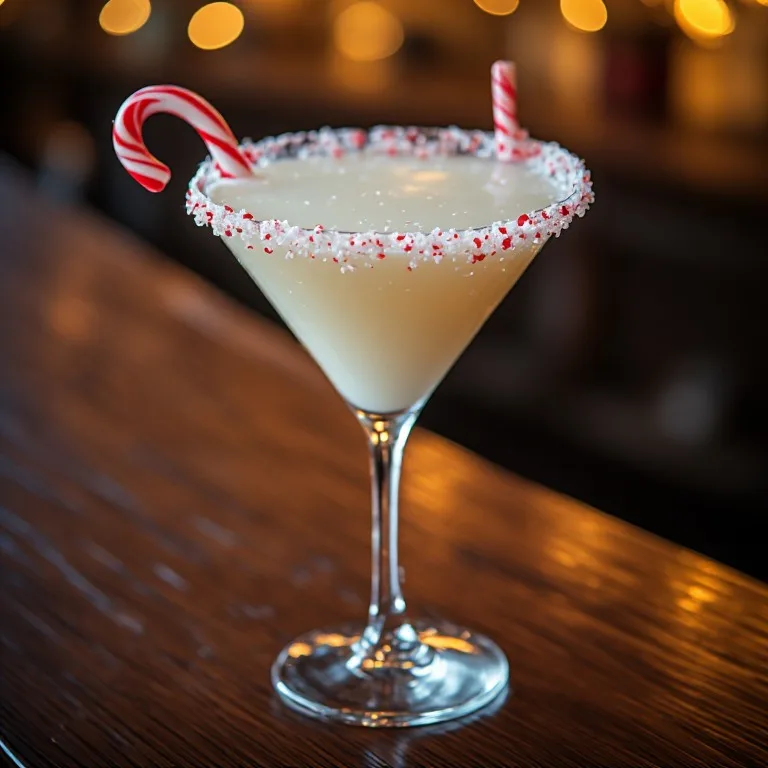
The Candy Cane Martini is a holiday dessert cocktail in a martini glass. It is not a gin martini, and it is not the signature of a particular bar. Vodka keeps the base clean, white creme de cacao brings cocoa sweetness, a short pour of peppermint schnapps supplies the mint, and cold cream pulls the glass toward peppermint bark. Crushed candy cane on half the rim does the rest of the December work.
There is no single published formula worth treating as law. Recipe pages have circulated creamy versions and clear versions for years, and the ratios do not match. This one is an original home balance for a Christmas party or a New Year’s nightcap: chocolate first, cool mint second, and still recognizably a cocktail.
Where the Candy Cane Martini Came From
No menu, trademark record, or dated first recipe establishes an inventor. The drink is a format that shows up whenever peppermint candy takes over grocery displays. The repeated parts are a clear spirit, something minty, something chocolate, often a dairy pour, and a candy cane on the glass.
Clear versions drink like sweet peppermint vodka. Creamy versions add heavy cream, Irish cream, or a whipped-cream-flavored vodka until the glass is closer to a milkshake. Some skip schnapps and use white creme de menthe, which pushes the mint toward candy and away from cocoa. All of those are real variations. None of them is an official spec, and none is tied to a chain that publishes a standard pour and a national price.
Pour it when the calendar actually calls for it. It sits naturally at a Christmas gathering or after midnight on New Year’s Eve. It is a poor match for a Thanksgiving table, where savory and cranberry drinks make more sense. November is a good month to shop the bottles, not to pretend the drink is an autumn classic.
Why Typical Versions Taste Like Mouthwash
Peppermint overload is the usual failure. Schnapps is already sweet, and a full rim of candy cane adds another layer of mint sugar. When the schnapps equals the vodka, the cocoa disappears and the finish tastes like toothpaste. Half an ounce is enough beside an ounce and a half of vodka.
The second failure is the wrong bottle. Many supermarket peppermint schnapps bottles are about 30 proof, which is 15% alcohol, and they taste like liquid candy. A 100-proof peppermint spirit is a different product. Use that at the same half-ounce and the drink turns hot and medicinal. Read the proof on the label before you pour.
The third failure is warm cream and a timid shake. Cold cream blends. A gentle stir leaves a slick of fat floating on sweet vodka. If the cream goes in at room temperature, the ice also melts faster and the last sip is thin.
The Key Technique: Rim Only Half the Glass
Crack one regular candy cane in a clean bag until it looks like small gravel, not dust. Dust vanishes into the drink. Large shards fall off before anyone takes a sip. A short pass with a rolling pin or the back of a spoon is enough. One cane rims one glass with candy left over.
Wipe only the outer half of the rim with a little white creme de cacao, then roll that half through the candy. Guests can choose a sweet sip or a clean one. A full rim also sheds sugar into the last inch of the drink and makes it gritty. Skip melted white chocolate unless you want a thicker, messier edge. The liqueur is sticky enough.
Shake the vodka, creme de cacao, schnapps, and refrigerator-cold cream with a full shaker of ice for about 12 seconds. Fine-strain into the chilled glass. Hang a mini candy cane on the bare side of the rim. It is a garnish, not a straw. If it sits down in the liquid, the color will bleed.
Batch the Spirits, Shake the Cream
For eight drinks, stir together 12 oz (360 ml) vodka, 6 oz (180 ml) white creme de cacao, and 4 oz (120 ml) peppermint schnapps. Keep that bottle in the refrigerator for up to a week. Leave the cream out of it. Dairy in a party bottle is on a short clock, and the shake is what emulsifies each glass.
Crush the candy canes the day you serve them. They pull moisture from the air and turn sticky if they sit overnight in a bowl.
For each drink, shake 2 3/4 oz (82 ml) of the bottled mix with 3/4 oz (22 ml) cold heavy cream and ice, then strain into a freshly rimmed glass. Rim the glasses within an hour of service so the candy stays crisp. If you are pouring for a crowd, freeze the glasses in the afternoon and rim them as people arrive.
The Peppermint Bark Mocktail
Take out the vodka and both liqueurs and you have sweet cream unless you rebuild the cocoa and the mint on purpose. Cold whole milk and heavy cream give the same texture. A teaspoon of peppermint syrup, not a full ounce, keeps the mint in bounds. White chocolate syrup stands in for creme de cacao. A short splash of strong peppermint tea adds a drier finish so the glass is not only sugar and dairy.
Check the syrup labels if someone at the table avoids alcohol entirely. Ordinary peppermint and white chocolate syrups are nonalcoholic. A product sold as a liqueur is not a syrup, even if the bottle looks similar. Shake the mocktail as hard as the cocktail. It should look pale and lightly frothy, with the candy rim doing the visual work.
The finished cocktail should taste of cocoa first, cool mint second, and vodka only as a clean warmth under the cream. If the mint arrives before the chocolate, the schnapps pour is too high or the bottle is the high-proof kind.