At Arnaud’s French 75 Bar, the namesake drink is not the familiar gin sour with bubbles. It is leaner, drier and built on Cognac. The result tastes like a bridge between a classic Champagne cocktail and a brandy sour, with lemon oil arriving before either spirit or wine.
That distinction matters. A generic French 75 recipe may be good, but swapping gin into it will not reproduce the glass served at this New Orleans institution.
What Arnaud’s Serves Now
Arnaud’s current bar menu lists the French 75 for $17 and names Courvoisier VS, sugar, lemon juice and Moët & Chandon. It remains the first cocktail on a menu devoted to elaborate originals and classic technique, so this is not an archival drink surviving only in old articles.
The live menu stops at ingredients. Fortunately, Arnaud’s and the French 75 Bar publish a house recipe: 1½ ounces of Courvoisier VS, 1 teaspoon of fresh lemon juice, ¼ teaspoon of simple syrup and 2¾ ounces of Moët & Chandon — the same Champagne the current menu names. That published formula provides a much firmer basis than guessing from the bare ingredient line.
The Origin Is Older Than the Bar
The French 75 Bar took its current identity in 2003. The cocktail is much older. Its name refers to the French 75-millimeter field gun of World War I, but claims that one famous bartender invented the modern drink in 1915 remain disputed.
The strongest documentary point is 1927, when Here’s How! printed the now-recognizable combination under the French 75 name. Harry Craddock’s The Savoy Cocktail Book spread a gin version in 1930. Cognac did not come from nowhere, however. Brandy and Champagne have a long affinity, and Cognac variations became part of the drink’s history. Arnaud’s did not invent the French 75; it made the Cognac interpretation a New Orleans landmark.
Why Typical Copycats Miss
Most modern recipes use equal pours of lemon and syrup, often half an ounce each. That makes a friendly sparkling sour, but it is far sweeter and more citrus-heavy than Arnaud’s published build. Here, a teaspoon of lemon sharpens the wine and just a quarter-teaspoon of syrup rounds its edge.
The second mistake is shaking the Champagne. Carbonated wine belongs nowhere near a closed shaker. Shake only Cognac, citrus and sugar, then add the bubbles in the serving glass.
Finally, use a dry sparkling wine. A sweet bottle turns even that tiny syrup measure cloying. True brut Champagne matches the current menu, but a quality dry traditional-method sparkling wine is the practical substitute at home.
The Key Technique: A Short, Cold Shake
Arnaud’s published directions say to shake only long enough to chill. Six to eight seconds with hard ice is enough for this small base. A long shake adds excess water and makes the finished glass feel thin once Champagne is added.
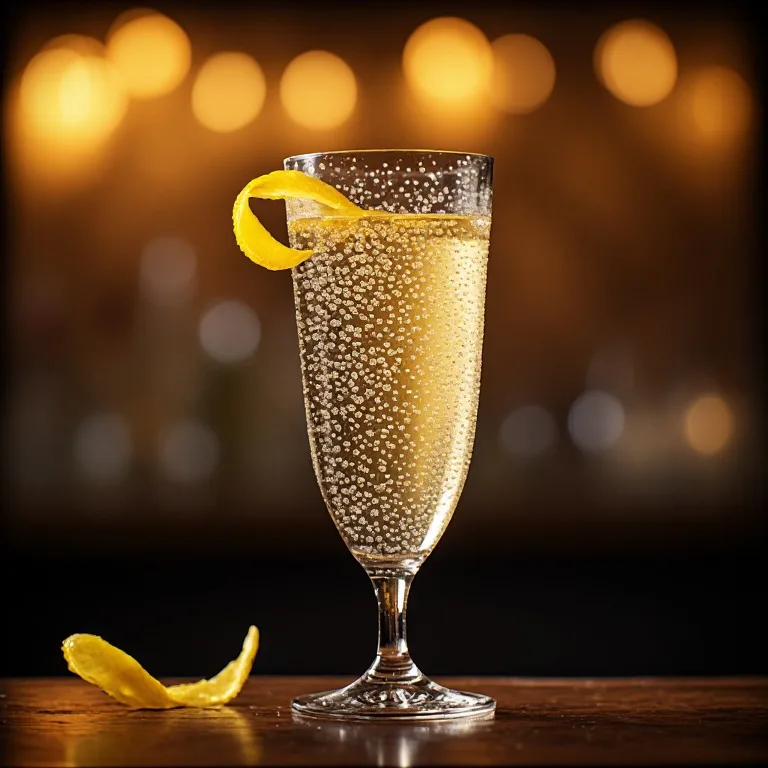
Fine-strain into a frosted tulip, then pour the sparkling wine slowly down the inside wall. A tulip holds aroma while giving bubbles room to collect. Express the lemon twist at the end. Its oil supplies much of the citrus impression because the juice measure is deliberately restrained.
Batch Eight Without Losing the Bubbles
Combine 12 oz (360 ml) Cognac, 1⅓ oz (40 ml) lemon juice and 0.32 oz (10 ml) simple syrup in a sealed bottle. Refrigerate for up to one day. Chill eight glasses and the Champagne separately.
For each drink, shake about 1⅔ oz (50 ml) of base briefly with ice, fine-strain and top with 2¾ oz (82 ml) Champagne. You will need roughly one standard 750 ml bottle of sparkling wine for eight. Do not add it to the batch in advance because stirring, pouring and storage will flatten it.
The Bienville 75 Mocktail
Removing both Cognac and Champagne can leave little more than sparkling lemonade. Strong black tea restores drying tannin, while white grape juice gives the base the soft fruit that tea lacks. Use decaf tea if serving late.
Look for sparkling wine labeled 0.0%, not merely “non-alcoholic,” if avoiding alcohol completely. Shake only the still ingredients, top with the cold sparkling wine and keep the lemon twist. The mocktail should finish crisp rather than sweet.
Arnaud’s version succeeds through restraint: a full Cognac pour, barely enough citrus and sugar to shape it, and more sparkling wine than mixer. Measure those tiny accents carefully and the drink becomes precise instead of austere.
See more famous bar and hotel cocktails →